Transactional Outbox in Spring Boot and Kafka: Reliable Order Events
Checkout succeeds, but fulfilment and confirmation never start. Explore the dual-write gap, then recover delivery with a transactional outbox and idempotent consumers.
The customer placed an order. Fulfilment never started.
A crash between saving an order and publishing its event can leave customers without confirmation and warehouse teams without work to fulfil.
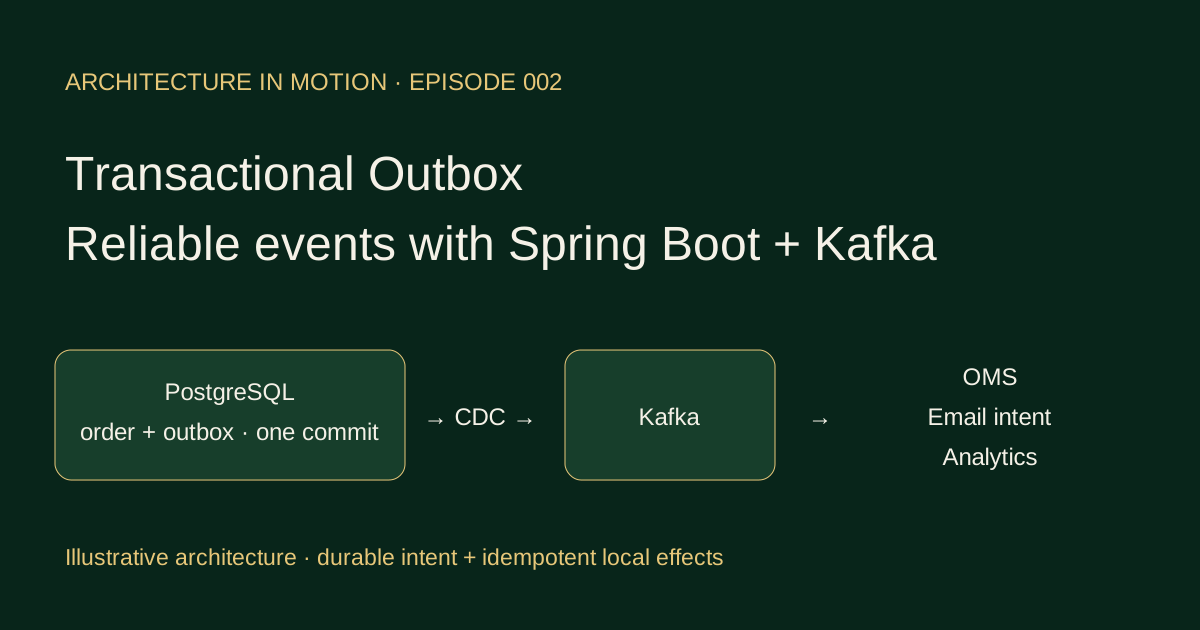
The fix: commit the order and event intent in one PostgreSQL transaction. Debezium relays the committed change to Kafka; consumers handle retries with stable event IDs. Delivery is asynchronous, not universally exactly-once.
See the problem.
Understand the rule.
Transactional Outbox in Spring Boot and Kafka: Reliable Order Events
Watch the idea in motion, then explore the model below. The article explains the implementation and its trade-offs.
Use the player controls to pause, seek, or enter fullscreen. The written explanation below is available at your own pace.
Open video separately ↗Break delivery. Recover the order event.
Start a new scenario with crash, outage, or rollback. Restore and replay continue the current scenario. Each consumer’s deduplication record and local business effect commit together in this model.
Result · Start with a crash, then compare durable outbox recovery.
Kafka: available · Event ID: e-904 · Order: #1042
0 fulfilment job
0 delivery intent
0 local write
- Order rows
- 0
- Outbox rows
- 0
- Kafka deliveries
- 0
- OMS jobs
- 0
- Email intents
- 0
- Analytics writes
- 0
- Duplicate checks skipped
- 0
Counts are deterministic teaching examples. A duplicate means redelivery, not necessarily another stored Kafka record. A durable outbox needs healthy database durability, CDC progress, retention, and recovery procedures.
Architecture in Motion · Episode 002 · October 27, 2026
Your checkout API returned 200 OK. PostgreSQL contains the order. But the customer never received confirmation, the order management system never started fulfillment, and analytics never counted the purchase. How can all four statements be true?
Watch the 74-second narrated animation above, then run the failure simulation below. This is a hypothetical production-style incident, not a report of an actual customer outage.
The real-world problem: a flash-sale order disappears downstream
Imagine an e-commerce store processing order #1042 during a flash sale. The checkout service saves the order and publishes an OrderPlaced event. Three independent services should react: an OMS creates a fulfillment task, an email service sends confirmation, and analytics records the conversion.
A fragile implementation might use this illustrative snippet. The save and send calls are separate operations; the Kafka send is asynchronous:
@Transactional
public UUID placeOrder(CheckoutRequest request) {
    UUID orderId = orderRepository.save(request).getId();
    kafkaTemplate.send("orders.placed", orderId.toString(), "OrderPlaced");
    return orderId;
}
Failure window: the method initiates an asynchronous send, then the database transaction commits when the proxied method returns. If Kafka publication later fails and there is no durable retry, the order exists without an event. A different implementation that commits first and sends afterward also has a crash gap. Depending on call timing and error handling, the order can exist without a downstream event. The reverse ordering—publishing before database commit—can produce a phantom event if the database transaction later rolls back. @Transactional alone does not make PostgreSQL and Kafka one atomic resource.
Business impact
A missing event can mean an order waits unfulfilled, a customer never receives confirmation, or a business dashboard undercounts revenue. A retry of the HTTP checkout request can introduce a second order unless the checkout API also uses an idempotency key. These are separate failure problems that require separate safeguards.
Architecture: transactional outbox + change data capture
Instead of publishing from the request thread, write the order and a description of the event in the same PostgreSQL transaction. A change-data-capture (CDC) relay publishes committed outbox inserts to Kafka later.
Atomicity boundary: orders and outbox_event commit together in one database. Delivery boundary: Debezium and Kafka operate asynchronously and can retry. Side-effect boundary: email, payment, and other external APIs require their own idempotency and reconciliation plans.
Step 1 — Create the tables
The following schema is simplified for teaching, but the outbox column names follow Debezium's default outbox event-router conventions.
CREATE TABLE orders (
    id UUID PRIMARY KEY,
    customer_id UUID NOT NULL,
    status VARCHAR(24) NOT NULL,
    total_amount NUMERIC(12,2) NOT NULL
);

CREATE TABLE outbox_event (
    id UUID PRIMARY KEY,                 -- unique event ID
    aggregatetype VARCHAR(255) NOT NULL, -- topic routing: orders
    aggregateid VARCHAR(255) NOT NULL,   -- Kafka key: order ID
    type VARCHAR(255) NOT NULL,          -- OrderPlaced
    payload JSONB NOT NULL,
    created_at TIMESTAMPTZ NOT NULL DEFAULT now()
);
Keep the outbox append-only for Debezium's default event-router transform. Avoid in-place status updates on outbox records in the CDC path. Plan retention and cleanup separately, after confirming connector progress and replay requirements.
Step 2 — Write order + event in one Spring transaction
The Java snippets omit imports and application configuration. They assume Spring-managed beans, a configured JdbcTemplate transaction manager, and external calls through the transactional proxy; they are teaching excerpts, not a complete application.
@Service
public class CheckoutService {
    private final JdbcTemplate jdbc;
    private final ObjectMapper mapper;

    public CheckoutService(JdbcTemplate jdbc, ObjectMapper mapper) {
        this.jdbc = jdbc;
        this.mapper = mapper;
    }

    @Transactional
    public UUID placeOrder(UUID customerId, BigDecimal total) {
        UUID orderId = UUID.randomUUID();
        UUID eventId = UUID.randomUUID();

        jdbc.update("""
            INSERT INTO orders(id, customer_id, status, total_amount)
            VALUES (?, ?, 'PLACED', ?)
            """, orderId, customerId, total);

        String json = mapper.valueToTree(Map.of(
            "orderId", orderId.toString(),
            "customerId", customerId.toString(),
            "total", total
        )).toString();

        jdbc.update("""
            INSERT INTO outbox_event(id, aggregatetype, aggregateid, type, payload)
            VALUES (?, 'orders', ?, 'OrderPlaced', CAST(? AS jsonb))
            """, eventId, orderId.toString(), json);

        return orderId;
    }
}
Why this works: if either SQL statement fails, the database transaction rolls back both writes. If Kafka is offline after commit, the outbox event remains durable in PostgreSQL until the relay catches up (subject to healthy database durability, CDC configuration, and log retention). No network call to Kafka is required inside checkout's database transaction.
Production refinement: persist a unique checkout idempotency key so HTTP retries cannot create duplicate orders. Include event schema version, correlation ID, trace ID, and only the customer data needed by consumers. For a real payment workflow, coordinate payment authorization, order state transitions, and compensating actions explicitly; the outbox alone is not a distributed transaction manager.
Step 3 — Publish with Debezium CDC
Debezium tails committed changes from PostgreSQL's write-ahead log and its Outbox Event Router transforms the insert into a Kafka record. An illustrative connector configuration excerpt:
{
  "table.include.list": "public.outbox_event",
  "transforms": "outbox",
  "transforms.outbox.type": "io.debezium.transforms.outbox.EventRouter",
  "transforms.outbox.route.topic.replacement": "outbox.event.${routedByValue}"
}
This is not a complete runnable connector configuration: a real deployment also needs the PostgreSQL connector class, replication slot/publication settings, credentials, broker endpoints, converter settings, and operational security. With the default mapping, aggregatetype=orders routes to outbox.event.orders, aggregateid becomes the Kafka key, and id becomes the event ID header. Using order ID as the Kafka key keeps events for that order together in a partition, supporting per-order ordering; it does not create a global order across partitions.
Step 4 — Make every consumer idempotent
At-least-once delivery means the same event can arrive more than once. For the OMS, insert an event ID into a unique processed-events table and create the fulfillment job in one local transaction.
-- In the OMS database, not necessarily the checkout database
CREATE TABLE processed_events (
    consumer_name VARCHAR(80) NOT NULL,
    event_id VARCHAR(36) NOT NULL,
    processed_at TIMESTAMPTZ NOT NULL DEFAULT now(),
    PRIMARY KEY (consumer_name, event_id)
);

CREATE TABLE fulfillment_jobs (
    order_id UUID PRIMARY KEY,
    status VARCHAR(20) NOT NULL
);@Service
public class OmsEventHandler {
private final JdbcTemplate jdbc;
private final ObjectMapper mapper;
public OmsEventHandler(JdbcTemplate jdbc, ObjectMapper mapper) {
this.jdbc = jdbc;
this.mapper = mapper;
}
@Transactional(rollbackFor = Exception.class)
public void apply(String eventId, String payload) throws JsonProcessingException {
UUID orderId = UUID.fromString(
mapper.readTree(payload).path("orderId").asText());
int firstDelivery = jdbc.update("""
INSERT INTO processed_events(consumer_name, event_id)
VALUES ('oms-service', ?)
ON CONFLICT DO NOTHING
""", eventId);
if (firstDelivery == 0) return; // already processed
jdbc.update("""
INSERT INTO fulfillment_jobs(order_id, status)
VALUES (?, 'PENDING')
ON CONFLICT (order_id) DO NOTHING
""", orderId);
}
}Your @KafkaListener reads the outbox event ID from the id Kafka header and delegates to this separate Spring bean. Configure offset acknowledgement, retries, and dead-letter handling so a failed transaction does not advance the consumer offset as if processing succeeded. An inbox row and business write must use the same local database transaction. For external email sends, a database-only dedup table does not guarantee the provider did not send twice if a crash occurs between the provider call and recording success; use provider-supported idempotency, an email delivery state machine, and reconciliation.
Try it: interactive failure simulation
In the interactive lab above, run the five scenarios: Naive dual-write crash, Outbox while Kafka is down, Restore Kafka, Replay the same event, and Database rollback (or Reset to start over). Observe order rows, outbox rows, Kafka events, and consumer effects. The numbers are deterministic illustrations, not live Kafka traffic or performance measurements.
| Scenario | Order row | Outbox row | Kafka event | OMS action | Meaning |
|---|---|---|---|---|---|
| Naive dual-write, crash before send | 1 | 0 | 0 | 0 | Committed order, lost event |
| Outbox committed, Kafka offline | 1 | 1 | 0 | 0 | Durable event waits for relay |
| Kafka restored and relay catches up | 1 | 1 | 1 | 1 | Event delivered and processed |
| Same event replayed | 1 | 1 | 2 deliveries | 1 | OMS dedup prevents a second job |
| DB transaction fails | 0 | 0 | 0 | 0 | Both writes roll back |
Architecture trade-offs and failure checklist
What you gain: atomic order/event intent, asynchronous fan-out, isolation from temporary Kafka outages, and the ability to replay consumers safely when they are idempotent.
What you pay for: additional database writes, CDC infrastructure, connector lag, WAL/replication-slot management, event schema evolution, monitoring, deduplication state, and eventually outbox cleanup. For a small system, a carefully implemented polling outbox relay can be simpler than deploying CDC, but it must coordinate workers and handle the crash-after-publish-before-marking-sent window; duplicates are still possible.
Operational checks: monitor connector source offsets, end-to-end event age, and consumer lag. In this append-only CDC design, a retained row is not proof that an event is unpublished; correlate relay progress rather than assuming a sent-status column exists. alert on stalled replication slots and WAL growth; ensure Kafka ACLs and TLS; avoid putting card data or unnecessary PII in events; add consumer retry limits and DLQ handling; keep event IDs stable across retries; test DB rollback, broker downtime, connector restarts, and duplicate delivery. Kafka's exactly-once processing features have a defined scope; they do not automatically make arbitrary external effects exactly-once.
Interview question: why not just use Kafka transactions?
Question: "Our producer enables Kafka transactions. Do we still need an outbox?"
Architect answer: Kafka transactions help atomically coordinate Kafka records and offsets within Kafka's processing model. They do not automatically make an ordinary PostgreSQL order commit and a Kafka publication one atomic transaction. If the order database is the source of truth, a transactional outbox closes that database-to-event dual-write gap. Consumers must still be idempotent, especially when they call external systems.
Primary references
- Debezium — Outbox Event Router
- Spring Framework — Rolling Back a Declarative Transaction
- Confluent — Kafka Message Delivery Guarantees
The scenario, order IDs, event IDs, and simulation outcomes are illustrative. No production incident or benchmark is claimed.
1. THE MISSING EVENT (0.0s)
Checkout succeeded. The order is in Postgres. But Kafka never received its event. How can that happen?
2. THE DUAL-WRITE GAP (8.0s)
Saving an order and publishing to Kafka are separate operations. A crash between them can lose the notification.
3. ONE ATOMIC COMMIT (16.0s)
Use the transactional outbox. Insert the order and its event in one database transaction. Both commit, or both roll back.
4. CHANGE DATA CAPTURE (25.0s)
Debezium reads the committed outbox insert from the database change log and publishes it to Kafka, keyed by order ID.
5. THREE CONSUMER GROUPS (33.2s)
Three independent consumer groups react: order management, customer notifications, and business analytics. A broker outage delays delivery.
6. RETRIES ARE NORMAL (43.2s)
Retries may deliver the event again. Consumers deduplicate using the event ID, and commit business updates with the deduplication record.
7. EXTERNAL SIDE EFFECTS (52.6s)
External email is another boundary. Use provider idempotency when available, plus retries and reconciliation. Never promise universal exactly once.
8. DESIGN FOR FAILURE (63.2s)
Monitor connector lag, protect customer data, test outages, and alert on failures. Reliable commerce is designed for crashes, not perfect networks.
Keep exploring
Questions about these trade-offs or a topic for the next article?
Start a conversation ↗Share on LinkedIn ↗Join the conversation
Was this lesson helpful? Leave a like or share a question.
Comments
Related articles
Kafka Retry Topics and Dead-Letter Queues: Handling Poison Messages in Spring Boot
One poison event can delay healthy orders. Learn bounded retries, dead-letter triage, idempotent processing and the ordering trade-off with an interactive Kafka failure lab.
Java 21Payment Idempotency in Spring Boot: Handling Timeouts and Retries
The gateway authorizes a payment but checkout never receives the response. Explore how stable keys, database uniqueness and reconciliation make retries safer.
JavaPostgreSQL Indexing and Keyset Pagination: Fixing Slow Order History
Shoppers wait for order history as orders grow. Learn how query shape, composite indexes, EXPLAIN, and keyset pagination reduce unnecessary database work.